The first day of our practice🗒📌😁
Very wonderful🥰
Very surprising🤩
Full of energy😁💪
Very interesting😊
And it was full of impressions😉


Lyabi-Hauz complex is associated with a romantic legend. Nadir Divan-Begi, the minister of the Bukhara Emir had decided to get married. He gave his bride only earings as a wedding present which obviously offended her. She was fully aware that her husband was born into a wealthy family and could easily afford a more generous present. But the groom kept silent without saying anything.
In few years time he had built a mosque, madrasah and a number of other constructions. His wife became indignant and told him that it was unfair to spend such huge amounts of money on the construction whilst giving her such a modest wedding present - she obviously hadn't forgotten her wedding slight. Her husband responded: "My dear, look in your jewelry box". When she opened the box she could see only one earring, and thought that she was robbed, when Nadir Divan-Begi explained to her that all the constructions he had built was constructed with the price of this one earring, haven't realized the value of my present, please enjoy something that was built thanks to this earring", he said to his wife. Her face must have been a picture then.

In the tea-houses of the Lyab-i-Khauz, where the lanes opened on a pool ringed with medresehs - religious schools - an immemorial conclave of old men lolled on wooden divans as if nothing had ever changed. Their heads were knotted in pale blue turbans or piled with sheepskin hats. Beards dribbled from their chins like fine wire. They sat at ease cross-legged, or dangled a hedonistic limb over the divan's edge, while the proprietors shuffled amiably between them, pouring out green tea from cracked pots. A gentle euphoria was in the air. Nothing sounded but the clink of china and a genial murmur of conspiracy. A breeze blew ripples over the water. Around them the religious schools looped in high gateways and blind arcades, in whose spandrels flew faience phoenixes. Here and there a facade cast a band of Koranic script into the sky, and under nearby plane trees a statue of Khodja Nasreddin, the wise fool of Sufi legend, rode his mad-faced mule.

Nasreddin was born in the family of the venerable Imam Abdullah in the Turkish village of Khorto in 605 AH (1206) near the city of Sivrihisar in the province of Eskisehir. However, dozens of villages and cities in the Middle East are ready to argue about the nationality and birthplace of the great cunning.
In maktab, an elementary Muslim school, little Nasreddin asked his teacher - domullah - tricky questions. The domulla simply could not answer many of them. Then Nasreddin studied in Konya, the capital of the Seljuk Sultanate, lived and worked in Kastamonu, then in Aksehir, where, in the end, he died.

Turkish professor-historian Mikayil Bayram conducted an extensive study, the results of which showed that the full name of the real prototype of Nasreddin is Nasir ud-din Mahmud al-Khoyi, he was born in the city of Khoy, Iranian province of Western Azerbaijan, was educated in Khorasan and became a student of the famous Islamic figure Fakhr ad-din ar-Razi.
The Caliph of Baghdad sent him to Anatolia to organize resistance to the Mongol invasion. He served as a qadi, an Islamic judge, in Kayseri and later became a vizier at the court of Sultan Kay-Kavus II in Konya. He managed to visit a huge number of cities, got acquainted with many cultures and was famous for his wit, so it is quite possible that he was the first hero of funny 😁or instructive stories about Khoja Nasreddin.
Go'zal speak about the Nodir devonbegi and its history:
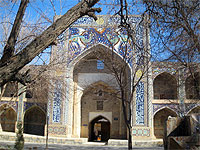 Nadir Divan-Begi Madrasah in Bukhara forms part of the renowned Lyabi-Hauz Ensemble, the city’s most venerated site which serves as the backbone of the Old Town quarters.
Built in 1622-1623, the madrasah and adjacent khanaka (building for Sufi gatherings) were named after Nadir Divan-Begi, a patron and defender of Islam who was one of the most influential nobles in the court of the powerful Imamkuli Khan of the Ashtarkhanid Dynasty.
Construction began with the khanaka, followed by a caravanserai which was soon converted into a madrasah by order of Imamkuli Khan. The transformation necessitated the building of a portal, covered corridors at the building’s four corners and the addition of second-floor cells for students. By order of Nadir Divan-Begi, a pool was dug in the center of the square between Divan-Begi Madrasah and Kukeldash Madrasah, now known as Bukhara’s Lyabi-Hauz.
Nadir Divan-Begi Madrassah is famous for the distinctive mosaics around its portal, lurid depictions of mythical Semurg birds clasping white deer in their claws. While the imagery of birds is hardly unusual in regional art of that period, they were typically portrayed in miniature paintings, embroideries and carpet patterns rather than on religious buildings. The Semurg bird was considered a symbol of happiness, while deer represented torment, the fleeting beauty of this world and the realization that man’s destruction of nature was bound to cause pain. The original mosaic was not preserved, and the current montage is a 20th-century restoration.

Nadir Divan-Begi Khanaka is located to the west of Lyabi-Hauz and faces the east. Like many monuments in Bukhara, the khanaka is associated with the Sufi order. Sufi dervishes would sometimes live for long periods near the grave of their order’s founder, while others went on pilgrimage, knowing they could find shelter and hospitality wherever they roamed. In many cities, the khanaka served as the crowded hub of their activities. Hungarian traveler and Asian historian Arminius Vamberi visited Bukhara in 1863 under the pseudonym of Dervish Haji Mahmud-Rishad, and in his memoirs he describes the dervishes, public orators, actors and numerous other participants of Nadir Divan-Begi Khanaka’s incessant action.
The Nadir Divan-Begi Madrasah and khanaka join with Lyabi Hauz and Kukeldash Madrasah inside the walls of Bukhara’s Old Town to form the Lyabi Hauz Ensemble, one of the key attractions in Bukhara today.
Nadir Divan-Begi Madrasah of Bukhara, along with the corresponding khanaka, were important spiritual centers of the city in historical times, and their active influence on the life and worldview of Bukhara’s inhabitants cannot be understated.

Kukeldash madrasah history
Kukeldash madrasah enters into the composition of the architectural complex Lyabi-Hauz. The madrasah was built in 1569 on Abdullah Khan's initiative. The constructed madrasah became the symbol of strong state during the governing of Abdullah Khan II.
“Kukeldash” literally means “foster brother”. In hierarchy of the power, inherited from Genghis Khan the word “kukeldash” marked one of the more important court positions. The organizer of Kukeldash madrasah was the authoritative Emir named Kulbaba. He was keeping his post of kukeldash for the period of several khans of Shaybanid Dynasty. Emir Kulbaba Kukeldash facilitated Abdullah Khan II during his rise to power. According to the sacred tradition of the election of the Khan, each new Khan was raised on the canvas of white skin. Only four most influential people in the society could pull the cloth. Emir Kulbaba was among those who enthroned Abdullah Khan.

This way Kukeldash madrasah was named after Kulbaba Kukeldash - high-ranking dignitary and famous Maecenas.


Class🥰🥰
ОтветитьУдалитьSurprising🌝
ОтветитьУдалить👍👍👍👏👏👏
ОтветитьУдалитьYour blog is best of the best 👍 😍
ОтветитьУдалитьThe best of the best
ОтветитьУдалитьBravo👏👏👏👏👏
ОтветитьУдалить🙃Our marvel groupmate💫
ОтветитьУдалитьThanks for your precious information💞
The best of the best 😋🤩🤩🤩🥰✌️
ОтветитьУдалитьWaw super😍
ОтветитьУдалитьGreat job🌟🤩
ОтветитьУдалить