Hello everyone☺️🤗🖐️✌️
Today has been a wonderful 🤩🤩day. To be honest, I thought 🤔it would be boring today. Because I thought that Fayzulla Khodjaev had little place to look 👀🎥at the house museum. But after seeing🙄 the place with my own eyes👁️👁️, I realized that I was lost. So today📑 is the eighth day of our practice and we visited the Fayzulla Khojayev House Museum at 10:20 am with our team members and our practice leader.
Nigina and Kamola were in charge of providing information about today’s Fayzulla Khojayev House Museum. I really liked the information they gave me.
For example, Nigina told about the life and work of Fayzulla Khojayev, and Kamola told about the establishment of the Fayzulla Khojayev House Museum.
- Bukhara
House Museum of Faizulla Khodjaev, Bukhara
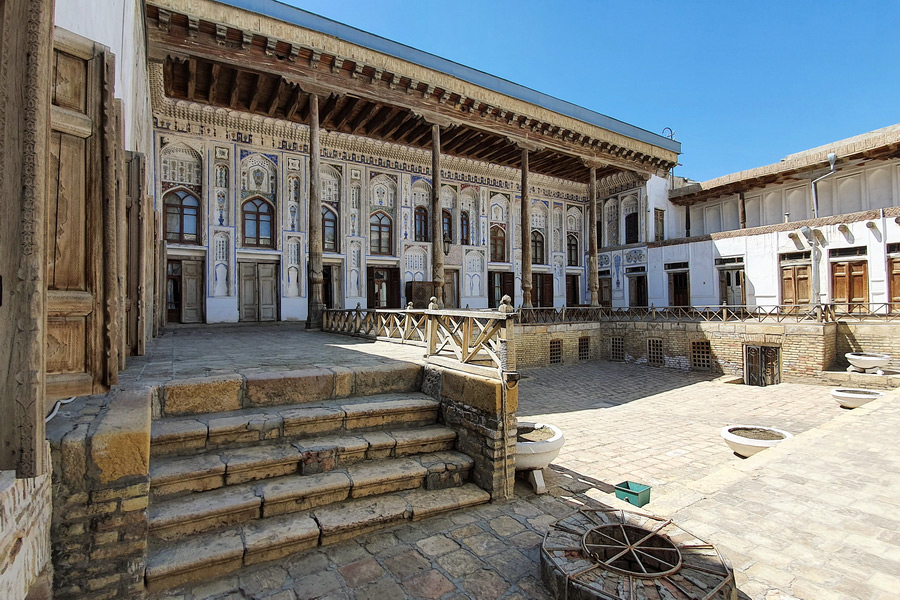
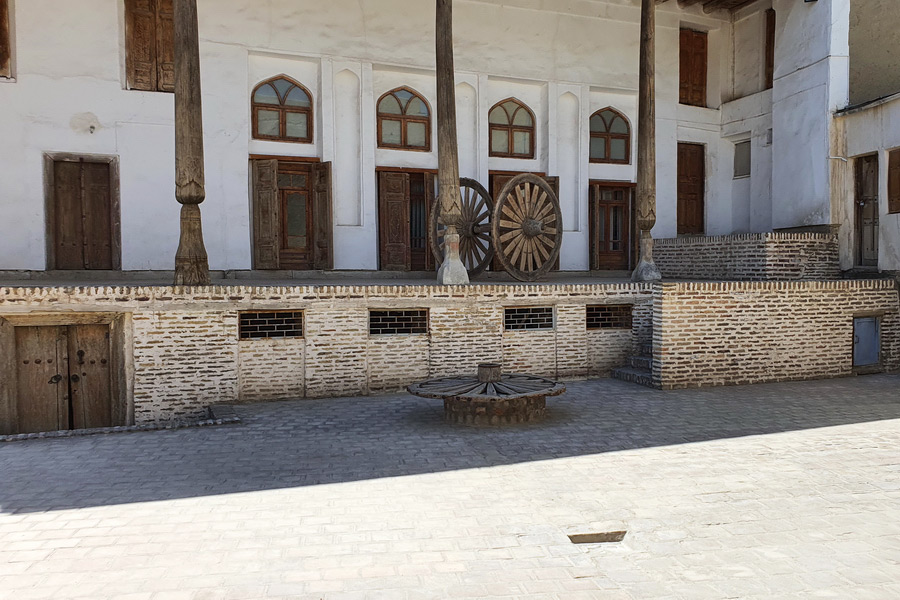
The House museum of Faizulla Khodjaev is a fine example of the Bukharan architectural style of the late 19th c., and is located in the house of his father, Ubaidulla Khodji, in the old quarter of Gozien. It has a large garden and is divided into two halves: the outer (for men) and inner (for women). The living area has a large reception room for guests, and summer and winter rooms with beautiful murals in the traditional Bukhara style.
A high wooden carved gallery (or "aivan") covers the main entrance. In the restored rooms * is original furniture and examples of clothing, crockery and other household items typical of the late 19th - early 20th cc.
The exhibition has some documents, photographs, books and other items which were saved despite Faizulla Khodjaev's persecution. Faizulla Khodjaev (1896-1938) was a leading state and political figure of Uzbekistan, born in Bukhara, who lived from 1896-1938. He was born into a rich Bukhara merchant's family and at the age of 17 took part in the Jadid movement and the activities of the Young Bukharans, after the 1917 revolution preparing an armed uprising and the overthrow of the emirate in Bukhara. From 1920-1924, Faizulla Khodjaev was the leader of the Bukhara People's Soviet Republic, and from 1925-37 he was first Chairman of the Soviet of People's Commissars of the UzSSR, one of the chairmen of the central executive committee of the USSR, and member of the central committee of the Uzbek Communist Party.

In June 1937 he was arrested, together with a group of leading revolutionaries and party workers (N. I. Bukharin, A. Ikramov, N. N. Krestinskii, A. I. Rykov and others), was tried in Moscow as part of the so called "right Trotskyist block", and in March 1938, shot. You can see traditional Bukhara clothing of the period, a traditional cradle or "garovabandon", and have tea and traditional Bukhara sweets.
Nigina and Kamola have approached their work very responsibly. Not only did they give us the information we needed today, but they also came up with questions to reinforce them. In short, I personally liked Nigina and Kamola’s preparations today. I wish them the best of luck in their future endeavors as well.
In short, today has been a wonderful day for me. The reason is that for the first time I visited the house museum named after Fayzulla Khojayev. I really liked that place. I took a lot of pictures there. I want to share these photos with you.
Photo with my Best and always lovely teacher and my dear coursemates🥰💜😇
Photos with my best friends 🥰🥰💜🤗
So, the eight day of our practice was very interesting and full of surprises. From today, I have received a lot of information that I need😁☺️🥳




Very good 👍👍👍no comment
ОтветитьУдалитьI also took a lot of photos 📸 🤫
ОтветитьУдалитьWow amazing💖✨😎💓💞
ОтветитьУдалитьGood job
ОтветитьУдалить